RESEARCH TECHNOLOGY • AI DEVELOPMENT
Teaching AI to Interview
TU Delft • 2025
The Problem
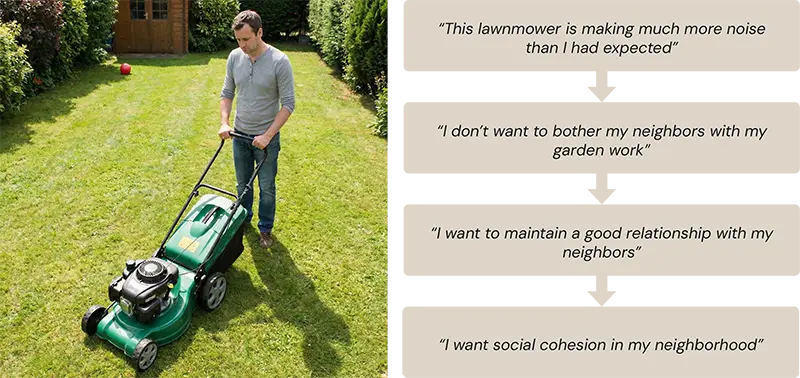
- — Our User Need Capture method yields deep, actionable insights by laddering from surface emotions to deep needs. It works brilliantly but doesn't scale—20 two-hour interviews require weeks of expert time.
- — Standard chatbots (like ChatGPT) can't replace trained researchers. They drift off-task and can't enforce protocols, track time, or log structured data.
My Approach
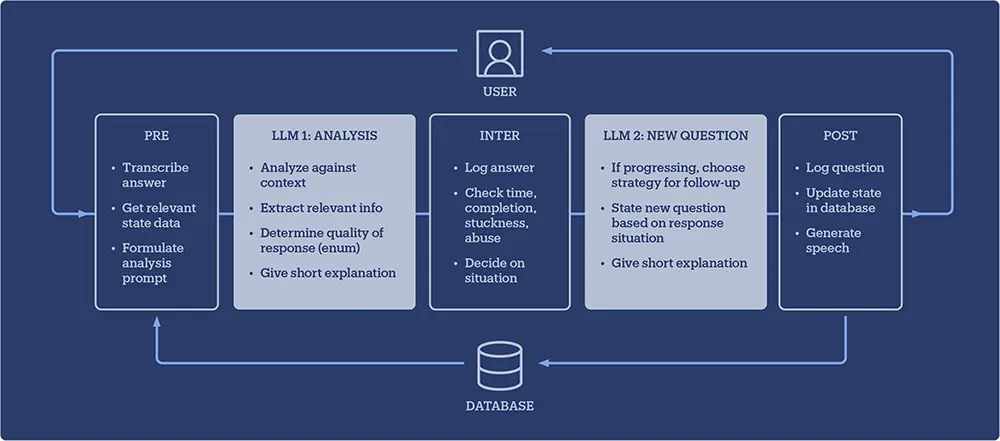
- — I architected a hybrid solution: the LLM acts as a probabilistic conversation engine within a deterministic application framework.
- — Traditional code (Node.js) handles state management, progress tracking, and guardrails. Two LLM calls per turn: one analyzes the answer, another generates an adaptive follow-up question.
- — This architecture enforces strict research protocols while maintaining natural, empathetic dialogue.
What I Delivered
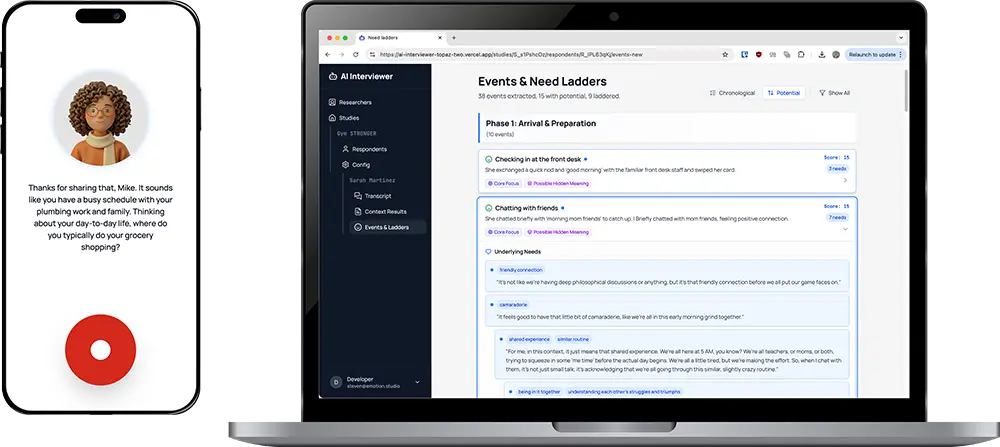
- — A voice-based web app (Next.js, AWS DynamoDB/S3) with three interview modules: Context, Event Discovery, and Need Laddering.
- — Respondents access it on their phone—fully conversational, no screens required. They can interview while relaxing at home or multitasking.
- — Researchers use a dashboard to create studies, manage respondents, and analyze structured results.
- — Built a testing suite with synthetic respondents to speed-run 168 scenarios and edge cases efficiently.
The Impact
75% reduction
in qualitative research costs while maintaining full methodological rigor
Deployed
at TU Delft for academic research about the emotional experience of interacting with AI